 Skip to content


Boundaries are the foundation of self-care, emotional well-being, and healthy relationships. They are the boundaries we create to honor our values, protect our emotional health, and build the life we want and deserve. In Imago Relationship Therapy, healthy boundaries aren’t about keeping people out—they’re about creating emotional safety, authenticity, and deep connection.
Often times, our boundaries are not based on our actual needs, but by childhood experiences, family dynamics, societal expectations, social media, and comparisons to others. Because we are products of our upbringing, it can be difficult to distinguish between boundaries that reflect our true selves and those rooted in fear, guilt, or compulsion.
According to Nedra Glover Tawwab, author of the New York Times bestseller Set Boundaries, Find Peace, boundaries are expectations and needs that help you feel safe and comfortable in your relationships. Everyone’s boundaries are unique. Some are preferences, others are hard bargains. Learning to differentiate is one of the most important communication skills we can develop. Simply put, healthy boundaries mean knowing when to say it yes and when to say are you here– no apologies, anger, resentment, or shame.
From an Imago Therapy perspective, boundaries become healthier when we understand how our childhood experiences influence our relationships today. Emotional intelligence allows us to respond intentionally instead of reacting to old wounds. Learning about how boundaries—or the lack of them—were modeled in childhood helps us create healthier relationships as adults.
Three Types of Relationship Boundaries
According to many relationship experts, boundaries generally fall into three categories.
Porous boundaries
Porous boundaries are weak, inconsistent, or underreported. They often include:
- People-pleasing
- They overextended themselves
- Enmeshment
- Fear of rejection
- The difficulty of saying no
- They lose themselves to meet the needs of others
These boundaries are vague, unforgiving and difficult for others to understand.
Hard boundaries
Rigid boundaries are often developed as protection from emotional pain. They can be:
- Building emotional walls
- Fear of being weak
- Distinguish yourself
- Stonewalling
- Conflict avoidance
- Experiencing situations when feelings are uncomfortable
While strict boundaries can feel safe, they often prevent the emotional intimacy needed for healthy, committed relationships.
Health Limits
Healthy boundaries require self-awareness, emotional accessibility, and clear communication. Respect both your needs and the needs of others when creating mutual respect, emotional security, and authentic communication.
Healthy boundaries are one of the foundations of successful Imago Relationship Therapy because they create the safety needed for meaningful dialogue and a lasting relationship.
Three steps to setting healthy boundaries

1. Change the Beliefs That Keep You Stuck
Before setting boundaries with others, it is important to examine the beliefs that drive your behavior.
Our childhood experiences greatly influence our ability to form healthy boundaries. Childhood trauma, neglect, conflicted caregiving, or over-parenting can make saying no scary or selfish.
Even those who grew up in loving homes often learn that acceptance comes with consistency rather than authenticity. Many of us have been what Terri Cole calls “abandoned their connections.” In particular, girls are often taught to be agreeable, to avoid conflict and “keep the peace.”
Imago Therapy teaches that these early adaptations often become unconscious survival strategies that persist into adulthood. We may sacrifice our own needs to maintain the relationship because it once kept us emotionally secure.
The good news is that boundaries are learned skills. When we become aware of old relationship patterns, we gain the freedom to create healthier ones.
2. Communicate your boundaries clearly and kindly
Healthy boundaries require honest and respectful communication.
Boundaries with Parents
As children grow, relationships with parents naturally develop. Healthy growth involves individuation—the process of becoming one’s own person while remaining emotionally connected.
Many older children are still afraid of disappointing their parents. At the same time, many parents struggle to see their older children as independent individuals rather than self-sufficient.
Instead of accepting unsolicited advice, older children can communicate their needs with compassion:
“I know you want the best for me, and I appreciate your concern. I have to make this decision myself, even if I make mistakes.”
This reflects one of the core principles of Imago Relationship Therapy: respect for both attachment and individuality.
Boundaries in Friendship and Everyday Life
You have the right to decide who has access to your time, energy and emotional space.
Instead of automatically saying yes, answer things like:
“Let me think about it and get back to you.”
Change your mind:
- I have the right to say yes.
- I have the right to say no.
- I can change my mind without guilt.
- My needs are also important.
Practicing these small moments of self-respect builds confidence over time.
Boundaries in Romantic Relationships
One of the biggest relationship mistakes couples make is to second guess their partner “just gotta know” their needs.
Even your wife can’t read your mind.
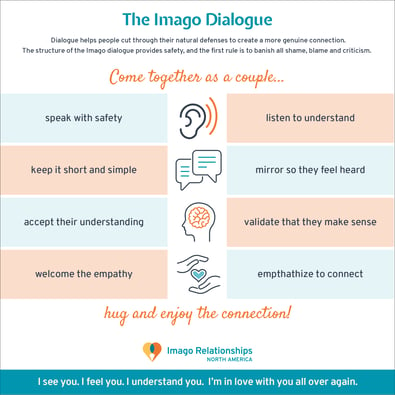
Imago Dialogue teaches couples how to communicate needs, feelings and boundaries in ways that reduce defensiveness and increase understanding. Instead of blaming or criticizing, friends learn to express themselves with curiosity, empathy and respect.
As past boundaries are discussed, the possibility of less anger has time to grow.
Navigation Limits with In-laws
Setting boundaries with the extended family is one of the most common problems couples face, especially in the early years of marriage.
Discuss concerns privately with your partner before talking to family members. Remember that it is normal for older children to be protective of their parents.
Instead of seeing the problem as yourself “your family against me,” Imago Therapy encourages men and women to approach conflict as teammates working on common understanding and mutual respect.
3. Follow Up with Simultaneous Action
Healthy boundaries only work when they are consistently maintained.
Every personal choice you make teaches others how to treat you.
Treat yourself with respect, kindness and compassion first. This sets the standard for every relationship in your life.
Nedra Tawwab encourages people to set boundaries around areas such as:
- Finance
- Time management
- Self care
- Emotional energy
- How others treat you
- Your inner dialogue
- Your reactions
- The people you allow into your life
When you first establish healthier boundaries, don’t be surprised if others push back. People naturally adapt to familiar patterns, and change can be uncomfortable for everyone involved.
Stay consistent.
Healthy Conflict Leads to Healthy Relationships

One of the core beliefs of Imago Relationship Therapy is that conflict is not the enemy of love—it is an opportunity for healing, growth, and deeper intimacy.
The conversations we avoid often become the anger we carry.
Having the courage to express your needs honestly can be uncomfortable at first, especially if you’ve spent years trying not to disappoint others. But vulnerability is the path to true connection.
Healthy boundaries don’t create distance—they prevent anger, increase emotional safety, and strengthen intimacy.
Working with an Imago Relationship Therapist or an Imago Marriage Therapist can help partners have these conversations in a safe, supportive environment where both people feel heard and understood.
When we learn to respect our own boundaries, we are naturally more able to respect the boundaries of those we love.
Finally, healthy relationships are not built on sacrifice – they are built on honesty, mutual respect, emotional security and conscious connection. Setting healthy boundaries allows us to experience one of the greatest gifts: being loved for who we really are.
If you need a little help with boundaries, bonding to build lasting love in your relationship, we’re here to help with our online and in-person Imago. Communication Workshops and Relationship Therapy.
Learn more about Imago with us Imago Professional Membership, Imago Professional Facilitators, Imago Professional Trainingand Imago Training Webinars.
Connections. Convert. Soul.
 Tory Joseph is a licensed clinical counselor, relationship therapist and parenting coach based in Florida, Maryland and works online. She works with couples, parents and individuals to address issues related to anxiety, grief, depression and loss of connection, in order to then gain understanding, healing and growth. Her clients deal with infidelity, divorce and family breakdowns. Tory has over 25 years of experience teaching, mentoring, and coaching parents. She is the mother of three grown children.
Tory will work to help you navigate difficult transitions, including a career change, empty nest, divorce, relationship breakdown, or the death of a loved one. It can help you to:
- Understand and solve problems in your life better.
- Manage difficult emotions, including anger and anxiety
- Improve decision making
- Create a healthy mix of work, leisure and relationships
Tory Joseph, M.Ed., LCPC, LMHC
Imago The Advanced Therapist
Certified parenting trainer
www.toryjoseph.com
counseling@toryjoseph.com